
 Apple Podcasts
 Spotify
 YouTube
 Podcast Addict
 Amazon Music
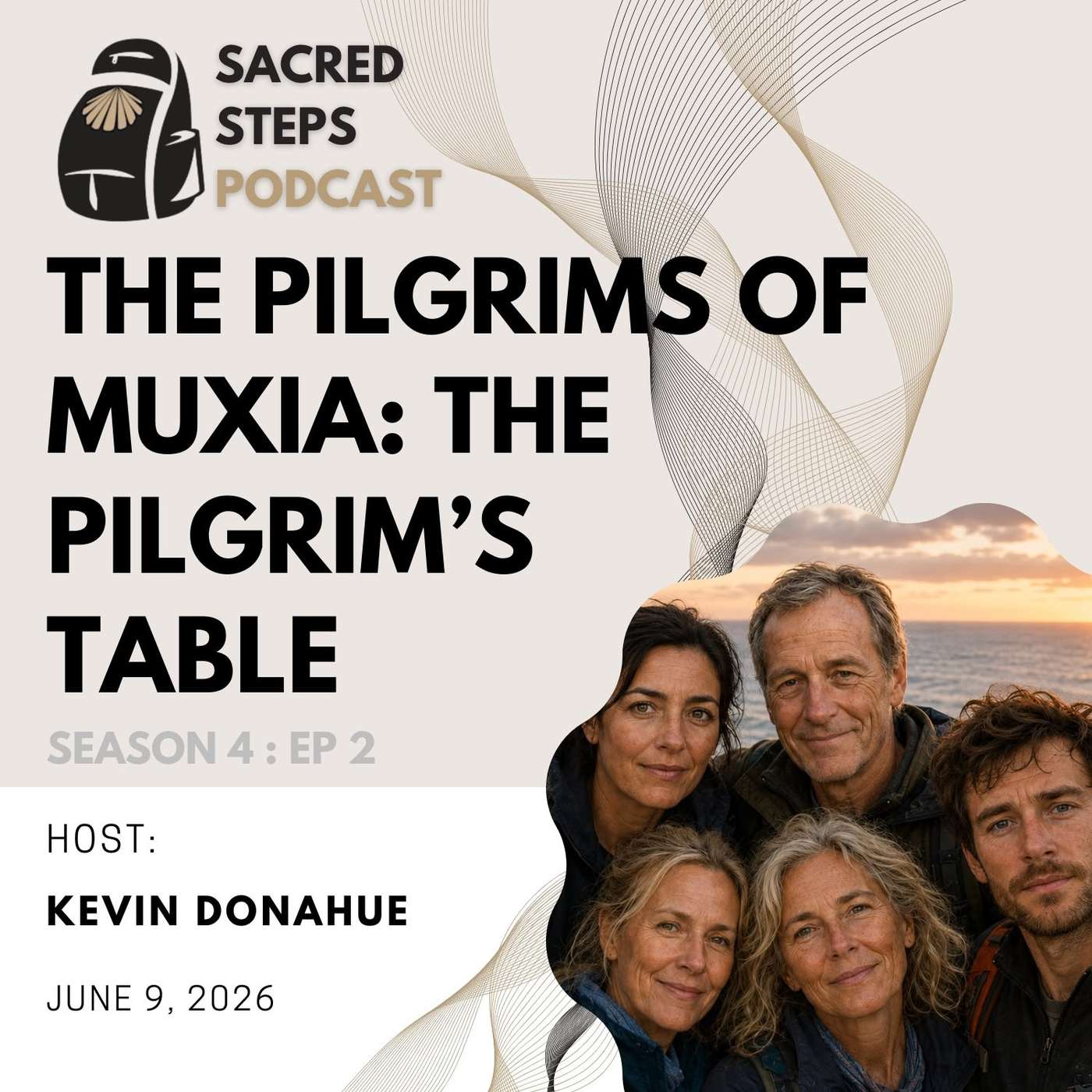
 Kevin Donahue goes inside his debut novel, The Pilgrim's Table, which is Book One of the Camino Chronicles series.
Five Camino pilgrims arrive, spent and searching, at Spain's final albergue to find unexpected grace... and discover their journey is only beginning. Book One of the Camino Chronicles. Available now at ThePilgrimsTable.com.
Genre: Literary Fiction
Series: The Camino Chronicles, Book One
Publisher: Sacred Steps Books / Chez Mer Studios
ISBN (Paperback): 979-8-9960935-0-2
ISBN (Hardcover): 979-8-9960935-1-9
Comparable titles: The Unlikely Pilgrimage of Harold Fry, The Five People You Meet in Heaven, A Man Called Ove
LINKS AND RESOURCES
The Book Get The Pilgrim's Table - hardcover, paperback, and digital: www.thepilgrimstable.com
Book Club Materials: The novel includes a full Leader's Guide, discussion questions, recipes from Matthieu's dinner menu, a Spanish-language guide, a pilgrim journal template, and a curated Spotify playlist. All available at www.thepilgrimstable.com
The Series The Camino Chronicles - series overview, Book Two updates, and news: www.caminochronicles.com
The Author Kevin Donahue - author home, writing, and updates: www.kevindonahue.com
Sacred Steps Books The publishing imprint behind the Camino Chronicles: www.sacredstepsbooks.com
Pilgrimage Resources Routes, planning, and pilgrim community: www.onestepthenanother.com
Contact and Inquiries inquiries@chezmerstudios.com
ABOUT YOUR HOST
Author Kevin Donahue (The Pilgrim's Table, Pilgrim Paths)began walking pilgrimage routes across Europe, the United Kingdom, and the United States in 2019 - including the Camino de Santiago in 2019 and again in 2023 with his son, the Via Francigena to Rome in 2024, the Pilgrim's Way from London to Canterbury, the Way of St. Cuthbert to Holy Island, and the California Missions Trail. After more than twenty-five years in luxury hospitality, he retired early to spend more intentional time with family and to pursue the work that matters most to him. He hosts two podcasts - Sacred Steps (pilgrimage) and Casual Mondays (early retirement) - and lives in Florida with his wife, son, and their two beagles, Otis and Larry.
★ Support this podcast on Patreon ★Go ahead and come in, oh, pilgrims, and welcome back to the Sacred Steps Podcast. On this show, we're walking virtually alongside pilgrims and authors sharing your stories and journeys of the road. And first, let me just say a tremendous, tremendous, tremendous thank you as a follow-up to our last episode where I discussed some of the reasons that I have been off the air. You have sent messages and emails and texts, and I am just incredibly grateful for your support. You also sent some questions about my new book that some of you pointed out I've been talking about since 2022, and they were really good questions.
Kevin Donahue:I appreciate the interest. So today, I wanna do something I haven't done yet in a full episode. I I wanna sit down with you the way I would sit across from a friend over a cup of coffee or maybe a glass of wine, and really walk you through it. The story, the characters, what it means, what it means to me, I think, and why I wrote it. No agenda, no sales pitch, just the honest version.
Kevin Donahue:So so let's sit down together and enjoy The Pilgrim's Table. So let me start with the question that I got asked probably more than almost any other regarding my new novel, The Pilgrim's Table, and that was why Muxia? Some of you were suggesting that ending the book in Muxia might have some specific connotations, or you questioned why not Santiago De Compostela. And first of all, I I think you're going to enjoy the book. I hope you will.
Kevin Donahue:Regardless of of where it takes place, the Camino is a bit of a metaphor for their internal journey. But if you've walked the Camino Francese or the Camino Portuguese or any of the 11 or 12 routes that Kevin Considine continues walking, you know Santiago De Compostela. You've stood in the plaza, maybe wept a little. I'm not judging. I cried like a baby the first time and then again the second time.
Kevin Donahue:And when Jack and I are walking again next year, I'm sure I'll cry again on that one. But we've all been there and felt the exhaustion and exhilaration of arriving somewhere you've been walking towards for days or weeks or even months. But here's what a lot of people don't know or forget. Santiago is not the end of pilgrimage, at least not for everyone. For centuries, pilgrims who arrived in Santiago De Compostela didn't stop.
Kevin Donahue:They kept walking another 90 kilometers or so west through the forest and the fog and the Galician villages all the way to the Atlantic Coast to a tiny fishing hamlet called Muxia. And there, at the edge of a rocky headland where the ocean kinda throws itself against these stones, they had no choice but to conclude their pilgrimage because there was nothing left. There was no more land, and only one guy can walk on water. Medieval pilgrims called this area Finistera, the end of the world, And for a Pilgrim who has been walking for weeks or months, sometimes carrying the weight of a life that they were trying to reassemble along the journey, arriving at the end of the world is no small thing. So that's where the Pilgrim's Table is set.
Kevin Donahue:Not in Santiago De Compostela, not on another large city along the Yellow Trail, in Muxia, at the edge, after the arrival, in the strange, quiet, holy that comes after. Because here's where I've come to believe after my own time on the Camino, the arrival is not the hardest part of the journey. What comes after the returning, the rebuilding, the figuring out who you are now, that's the hard part, and that's exactly what the Pilgrim's Table is about. The Pilgrim's Table is the first novel in my Camino Chronicles series published under the Sacred Steps Books label. It follows five pilgrims who've each walked different routes to reach the coast of Galicia.
Kevin Donahue:They don't know each other. They've walked alone, and they they end up altogether one October evening at a small albergue, a place called Chez Mere. You may recognize Chez Mere from the Chez Mere studios. You may also know my wife's name is Maren. And so Chez Mere, which is French for house of the sea, makes perfect sense because the host at Chez Mer is a Frenchman named Matteo.
Kevin Donahue:So he is a former executive chef in his mid fifties who left a celebrated kitchen at a hotel in Geneva, Switzerland after his grandmother pointed out that he had forgotten something important about why people cook. So he comes to Muxia. He opens in Albergue and has been feeding pilgrims from her provincial recipe book ever since. Matteo has never walked the Camino himself, and that's important. We'll come back to it.
Kevin Donahue:So over a single evening, one dinner, one table, six chairs, a communal meal, five strangers sit down with their host. And what begins as polite conversation, the kind you have with people that you're probably never going to see again, slowly becomes something else. And if you've had communal dinners, maybe you've experienced this. For me, the last one I can recall was at, I believe, Casa De Jesus outside of Padron on the Camino Portuguese. But the evening slowly becomes something more than just this polite conversation.
Kevin Donahue:It's usually laughter and, you know, some some shared insights, and and eventually, the conversation will turn a bit more serious, a bit more inward. And in the right setting, you start to get these deeper conversations, these confessions, and sometimes an unexpected grace from those strangers sitting with you. The novel itself takes place in about twenty four hours, roughly twenty four hours. We have afternoon arrivals, the dinner, the night, the morning, and then departures. And that compression was very intentional.
Kevin Donahue:I wanted the intimacy of a small Camino table, which if you've ever sat at one, you know, has kind of a accelerant built into it because the Camino strips away all of our social armor faster than almost any other environment. People tell you things at those tables that they might not say to their closest friends, partly because you're a stranger, partly because we are all equals. It doesn't matter if you're the CEO of a company, a parent, an alcoholic, anything that you carry as identity is essentially gone on the Camino because ultimately you are a Peregrino, And we're all hot and tired and sweaty and hungry, and we're all sitting there, and we're all ready to share. And that's the engine of this story. Okay.
Kevin Donahue:Let me introduce you to the characters because this is a novel, and it would be nothing without these five people. So I want you to feel like you know them before the meal even starts, before you've had a copy of The Pilgrim's Table in your hand, which I guess I should say at some point is available at thepilgrimstable.com. So we have Claudia. She's 55 years old. Boston.
Kevin Donahue:She's just walked a hundred and twenty seven days from France, the Via Podiensis, one of the great French pilgrimage routes, arriving finally at Muxia. Claudia had never carried a backpack before this walk. She had never traveled alone before doing the Camino. She walked away from a twenty three year marriage that had been, as I describe it, quietly erasing her. She ended up signing her divorce papers at the post office in Santiago.
Kevin Donahue:She signed them between pilgrims with a line forming behind her and a clerk who looked bewildered by the whole thing. And I love that detail because that's what the Camino does. It asks you to do the most important things in the most ordinary of places. When you're reading, you'll see that Claudia's emotion kinda lives in her hands, and that's something that I was very intentional about with her. You'll you'll see that the way she carries everything is is demonstrated in how she holds things, how she sets them down, when she sets things down, how she reaches across the table.
Kevin Donahue:Claudia, in the book, doesn't make speeches because that's not who she is. She moves. Alex is 27 years old from Portland, Oregon. He's walking the Camino Francese as he is eight months sober, or I should say he was walking the Camino Francaise. On day six of a five week walk, he slips on the cobblestones and tore up his ankle badly enough that he can no longer walk the route.
Kevin Donahue:So he's been continuing towards Muxia by bus and taxis, texting with his sponsor back in The States, carrying a bright orange Gregory backpack, and a voicemail on his phone that he only plays when he needs to. Alex is the son of a charming, unreliable, alcoholic father. He's still, as I write it, trying to outwalk that shadow. And if you know anyone in this situation or if you're in this situation, I hope this presents authentically because his recovery arc in the novel is not neat and tidy. I was very deliberate about that.
Kevin Donahue:There's no breakthrough moment where everything resolves and the little Disney birds come flying out. Recovery is a direction, and in talking with some of you on the podcast, you know, I've learned more about that. It's a direction and not a destination. And so that's something Alex says quietly himself over dinner. His question throughout this whole story is a simple one, and we have talked about it so many times on this podcast.
Kevin Donahue:But what makes you a Pilgrim? If you arrive by bus, are you a Pilgrim? If you show up broken and wholly incomplete, have you finished? And the answer that the novel builds toward and the answer that the novel builds toward, and one that I believe absolutely comes through the other characters, through Matteo, through the dinner itself, is yes. Of course it counts.
Kevin Donahue:The wound you carried the whole way, you carried the whole way. These next two are fun characters. I loved writing them. They remind me of a few people that I've had the opportunity to walk the Camino with. So Dan and Jenny Kowalski from Winnipeg, shout out to my Canadians.
Kevin Donahue:They're married thirty seven years, and this is their fourth time walking the Camino together. So Dan is an economist who studied medieval history and never really quite forgave himself for choosing a more practical career path. He knows everything about the historical Camino, the routes, the saints, the infrastructure of Pilgrim hospitality, and he delivers this information in long, sometimes aggravatingly long to his wife, but beautifully structured paragraphs whether anyone asks for them or not. And Dan, in a lot of ways, is just a love letter to the Camino. Everything that is romantic about the Camino is represented in Dan.
Kevin Donahue:Now Jenny, who is a nurse supervisor, manages Dan with clinical patients. They are, on the surface, the grounded couple. Right? They they sort of anchor the story, if you will. They seem to have their lives figured out.
Kevin Donahue:But what the the novel explores gently without much drama is that they're at the threshold two. Retirement is approaching. The structure that held them for almost four decades is loosening, and the dream they've been carrying for three Caminos, a stone house, a good kitchen somewhere in Spain, we we've all done that. Right? That dream is beginning to feel less like a dream and more like a decision that needs to be made.
Kevin Donahue:Isabella Hernandez is a history teacher from Barcelona. She walked the Via De La Plata from Seville more than 1,100 kilometers. One of the longer and less traveled routes, she carried a stone taken from her brother's garden. Her brother's name was Javier. He planned to walk the Camino prior to his death.
Kevin Donahue:He had a notebook, and he had stages mapped out, every day charted, every stop noted. Isabella finds the notebook and begins walking his camino. She is walking toward understanding, I think, not just of grief, but of the particular grief, the particular weight that is complicated by a final argument with Javi that she can't take back. So there's a guilt in her pack alongside everyone. So there's a guilt in her pack alongside everything else.
Kevin Donahue:Isabella's voice in the novel is precise and structured as you would expect because she's a teacher and she organizes things into frameworks, even her grief. And her conversations in particular with Alex at Chamere become one of the quietly transformative threads in the book, I think for both of them. And then we have our host, the chef, Matteo. I think I mentioned earlier that he has never walked the Camino, and that's important. He is the heart of the table, which the whole novel turns around.
Kevin Donahue:He left a 300 cover restaurant because his Mei Mei, his grandmother, reminding him that cooking was supposed to be an act of love, not performance. And so he comes to Meshia with her recipes and her philosophy, and he opens his door to pilgrims at Annalburgue. And I think Matteo's story is is really what the what the novel itself is about in the end. The five pilgrims that come through his door are also, without knowing it, without realizing it, and probably all the pilgrims before them, walking Matteo's Camino for him. Every story they bring to his table is a step that he hasn't taken.
Kevin Donahue:And he is reaching a point where he's realized that the the mountain that he climbed in his life, in his adult life, was the wrong mountain, and that can really impact someone. And by the morning, he'll understand that what he's been watching from his kitchen window for three years is really beckoning to him. I wanna talk to you really quickly about the what the book is actually saying because I'm aware from the outside that you might describe The Pilgrim's Table as a charming little novel about dinner. And it is, by the way. You know, if you want the recipes from the dinner, they're available at the website, thepilgrimstable.com.
Kevin Donahue:But there are a handful of ideas underneath it that I care deeply about, and as long time listeners, you will recognize these very quickly. Ideas I came to through my own walks, my own transitions, my work on this podcast with guests who have been generous enough to share their pilgrimage stories with us. The first idea is this. Pilgrimage cannot remove the weight you carry. It only helps you adjust the weight to make it more manageable.
Kevin Donahue:I'll say that again. Pilgrimage cannot remove the weight you are carrying. It can only help you adjust the weight so that you can carry it better. This is the beating heart of the whole Camino Chronicles series. I see it stated as encouragement sometimes.
Kevin Donahue:The Camino will heal you. Leave your burdens at Cruz De Ferro. And I understand the impulse behind that, but I've sat with enough of you and enough Pilgrims before and after to know it's not quite accurate. Claudia's marriage is still over when she sits down to dinner. Alex's father is still his father, and he is still a recovering alcoholic.
Kevin Donahue:Isabella's brother, Javi, is still gone. The walk doesn't fix any of that. What it does is change how they carry it. That's a different and, I think, more honest thing. The second idea is the distinction between watching a life and walking through one.
Kevin Donahue:Mateo has been watching pilgrims at the Albergue for three years. When he was a little boy, he watched pilgrims leaving from the square. He knows what they need. He nourishes them. He listens to them.
Kevin Donahue:He cares for them. And yet, there's something he hasn't accessed in himself because he's always been on the other side of the door. He's always been on the other side of the table. And so at one point in the night, as a discussion is going on and he's Matteo's talking about his his career and and watching the Pilgrims and and these wonders that he has, Dan confronts him a little bit and says bluntly at one point, you know, stop watching. If it matters to you, then stop watching and do it.
Kevin Donahue:And I think that's a really important part of the book. And this is the question that I ask myself, honestly, as someone who interviews pilgrims and authors as a podcaster, am I in the arena, or am I observing it? Most of the time, the answer is both, and the book kinda lives in that tension. The third idea is that of the table as this sacred space. Many of you know I spent almost thirty years working in luxury hospitality before I retired last year, I know what a well set table can do.
Kevin Donahue:I've seen it in four star restaurants. I've seen it in Albergue dining rooms with mismatched chairs and candles plunged in the top of wine bottles. A table where people feel safe and unhurried and and genuinely seen is not decoration. It's not furniture. It's it's almost a spiritual practice.
Kevin Donahue:Matteo's grandmother teaches him that cooking is love made tangible. Cooking is love made tangible. It's not a sentiment. That's theology. Right?
Kevin Donahue:The Camino has always had a theology of hospitality built into it. The medieval pilgrim hospitals, the monasteries that open their doors, the locals who for a thousand years have put out water or fruit or nuts along the route. The Pilgrim's Table was my attempt to put that theology into a single evening, a single table in Meshia. The fourth idea, and this one is close to me personally, is that second acts are real. Midlife crisis doesn't have to be.
Kevin Donahue:It can be a departure, but it can also be a beginning. Matteo left Geneva in his middle age. Claudia begins her walk at 55. Dan and Jenny are renegotiating everything in their sixties. These are not characters failing to hold on to their youth.
Kevin Donahue:They're characters that are brave enough to admit that the map they were following no longer shows the territory they're actually in. Right? As they age, their lives continue to transform, and so too should their story. I was blessed to have the opportunity to retire early. I walked the Camino with my son.
Kevin Donahue:I started a podcast. I spent many, many years writing a novel. I know this space from the inside, and I wanted to write characters who reflect it honestly without making it a triumphant montage and without making it a tragedy. It's neither. The Camino was a walk, a long one.
Kevin Donahue:And for me at least, it turns out that the company makes all the difference. I wanna read to you something from the novel. It's one of the selected quotes I've shared publicly, and it comes from Isabella, the Barcelona teacher in a conversation with Alex that they have very late in the evening. She says, the wound doesn't get smaller, Your understanding of it gets larger. And that's it.
Kevin Donahue:That's the whole book in a single sentence. See, I just saved you 400 plus pages. I think about that line a lot. I think about it when I hear Pilgrims who've just come back from a Camino, and they don't really quite know how to reenter their lives. And I think a lot of us has been there.
Kevin Donahue:I think about it when I hear from people who went looking for a cure and instead found a conversation that Camino is so good at conversations. The ones you have with the road, with strangers, and eventually, if you allow it, the conversations you have with yourself. Let me tell you a little bit about where the Pilgrim's Table goes without spoiling the evening's dinner entirely. Over the course of the night, each Pilgrim surfaces the thing that they've been carrying. Claudia develops a a slow revelation.
Kevin Donahue:She doesn't lead with her marriage. She waits. She listens. And when she finally says it out loud at a table of strangers, it lands differently than it would have anywhere else. That's the gift of a Pilgrim's Table.
Kevin Donahue:For Alex, his tension is present from the moment he arrives at the Alburge and on display over dinner. He's tracking how many glasses of wine have been poured, watching the bottle. He tells Isabella about it, not in a dramatic confessional, but quietly as one person describing their internal weather to another. I think it's one of the most honest scenes in the book. I spent an awful lot of time rewriting it because the concept was a lot harder than I probably have the talent to write, but I really wanted to earn it.
Kevin Donahue:For Dan and Jenny, their resolution involves Matteo. And I don't wanna give too much of the book away, but I will say that by the end of the evening, Matteo's future is more certain, and so is Dan and Jenny's. Isabella carries a stone from her brother's garden. There's a moment with the stone that is kind of quiet and unremarked upon by the other characters that I hope stays with you the way certain moments on the Camino stay with you. Not not the big ones arriving in Santiago De Compostela, the the small ones.
Kevin Donahue:The ones where you realize something shifted and you can't quite say when it happened. So that's book one, The Pilgrim's Table, which brings me to book two and book three of the Camino Chronicles. Book two begins almost instantly from the end of book one. I made the decision to self publish these, and I wanna say something briefly because I think it matters about self publishing. This is a book that I think touches multiple generations.
Kevin Donahue:It has grief in it, recovery in it, retirement in it. It has quiet faith, not doctrine heavy faith, but the kind you find when you've been walking alone for six weeks and you sit under a tree, and you look up and you see the amazing sky and you realize something has changed. That's a hard book to categorize for a publisher because it doesn't fit neatly into a single shelf. Right? Is it romance?
Kevin Donahue:Is it theology? Is it science fiction? But you know who doesn't care about shelves? Pilgrims. Camino pilgrims know this story because they've lived some version of it.
Kevin Donahue:So I took it directly to the people it was written for, and so far, with many thanks, your response has been extraordinary. Book two is already in production. I hope to finish it over the summer or into the fall and have it out in early twenty twenty seven. I think I've hinted around at it enough. I think you're finding that Matteo may have a Camino in him from his hometown.
Kevin Donahue:It's a great pilgrimage town, by the way. Dan and Jenny are in the second book. Claudia is in the second book, although she finds herself in Tuscany. Isabella is moving away from Barcelona. We find that Alex is trying a different route, a different test of his sobriety, and we have new characters arriving.
Kevin Donahue:Most of the book is not set in Muxia, but Shaimer is there, and we have Pilgrims arriving and the table setting itself and doing what the table does. Book three, Matteo is home, but I'll let that story find its shape first. I wanna take a minute before we close to say something that really isn't about the book at all. If you're someone who has walked the Camino or any pilgrimage route and come home and struggled to explain what it meant, I wrote this book for you. Not to explain it for you, but to sit beside you in that silence where walking has stopped but the questions haven't.
Kevin Donahue:If you've never done a walking pilgrimage and you never plan to, but you recognize yourself in some of the the characters who are who are trying to find who are you becoming. Who are you becoming? I wrote this book for you too. The routes are real. The shells, the arrows, the albergues, the blisters, they're all real, but pilgrimage at its deepest is an impulse.
Kevin Donahue:People have walked towards something they couldn't quite name for centuries, and every faith has a tradition and a version of it. The Camino is just one of the more well marked trails. And if you're somewhere in the middle, considering pilgrimage, planning your walk, dreaming about the walk, working up the courage to walk, I see you. Maybe this book will help you understand what you're actually considering. This is not a travelogue.
Kevin Donahue:It is not a guidebook. It will not tell you what to pack or how to wash your socks or how to train or which route to choose. But it might tell you something about who shows up at the end of the journey and what they find sitting around a table at the edge of the world. A few quick details before we close. The Pilgrim's Table is available now for presale.
Kevin Donahue:You can find it at the pilgrimstable.com. Available at Amazon, Kindle, signed copies, paperback, and hardcover, as well as book club versions are all at the pilgrimstable.com website. On or about July 1, you'll be able to find it at local bookstores, either in stock or on special order, as well as Amazon, Barnes and Noble, and your favorite bookseller websites. If you've read it, please consider leaving a review wherever you purchased it. Reviews are the fuel that keeps small press books moving, and every single one matters.
Kevin Donahue:I am not Random House. I don't have an army of promotions, PR, marketing, and book relations people. I just have you and me. That feels like enough. For book clubs, the novel comes with a full leader's guide, including discussion questions, recipe cards from Matteo's menu, Spanish language guide, a Pilgrim journal template, musical playlist, some activities to do, like making a pilgrim scrapbook or pilgrim's shelves.
Kevin Donahue:Matteo would want you to have food on the table, so plan accordingly for book clubs. There is a discount available for book club leaders to purchase books in bulk at thepilgrimstable.com. If you wanna follow the broader journey, the Camino Chronicles, Sacred Steps books, and everything happening at the Chamere Studios, you can always find me at kevin donahue dot com. I would love to hear more from you, especially about how you're experiencing the book and your walks, and to have you on the podcast. Please reach out.
Kevin Donahue:My table has always been big enough. Sacred Steps Podcast. All the notes from today's episode are at sacredstepspodcast.com. Subscribe wherever you listen to podcasts. And if you're enjoying the show, please share it with someone who would understand why a person would leave everything behind to walk across another country.
Kevin Donahue:Those people, they are your people, and they'll know what this is. To my fellow Pilgrims and all the hosts who set the table for us along the way, physically and emotionally, I'm Kevin Donahue. Until next time, be well, stay safe, and buen camino. Hi.