
 Apple Podcasts
 Spotify
 YouTube
 Podcast Addict
 Amazon Music
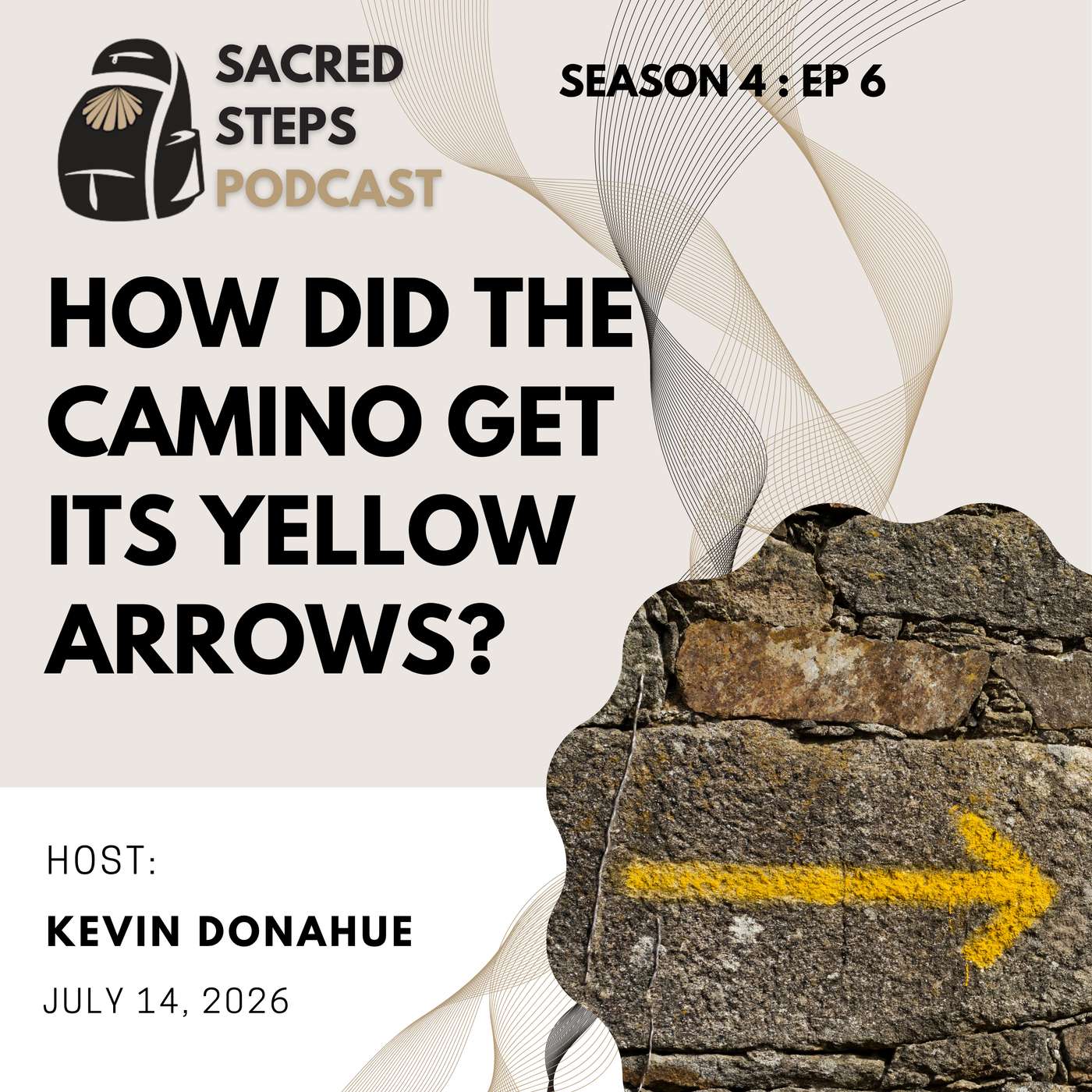
 Every pilgrim learns to trust it within a day: a splash of yellow paint pointing the way to Santiago. It feels ancient — but it's younger than color TV. This episode tells the story of the stubborn parish priest, the battered Citroën, and the cans of leftover paint that quietly rescued the Camino de Santiago from disappearing altogether.
Links & resources
- Turismo de Galicia / Xunta de Galicia (official) — "The yellow arrow":https://www.caminodesantiago.gal/en/discover/the-way-at-the-present-time/the-yellow-arrow
- Xunta de Galicia via Google Arts & Culture — "Yellow Arrows and the Vieira":https://artsandculture.google.com/story/yellow-arrows-and-the-vieira-xunta-de-galicia/nQUB7TIHR-WRbQ
- Federación Española de Asociaciones de Amigos del Camino de Santiago: https://www.caminosantiago.org
- Australian Friends of the Camino — origin of the yellow arrows: https://www.afotc.org/pilgrim-resources/ever-wondered-about-the-origin-of-the-yellow-arrows-along-the-camino/
CONNECT WITH THE SHOW ONLINE:
Podcast Homepage — sacredstepspodcast.com https://www.sacredstepspodcast.com
Kevin's Novel: The Pilgrim's Table https://www.thepilgrimstable.com
Sacred Steps Books Author Store: https://www.sacredstepsbooks.shop
Stream the Video Podcast on YouTube https://www.youtube.com/@sacredstepspodcast
Connect on Facebook https://www.facebook.com/sacredstepsbooks
View on Instagram https://www.instagram.com/sacredstepsbooks
MEET THE HOST: Kevin Donahue
Husband. Father. Backpacker. Pilgrim. Author.
Kevin Donahue began walking pilgrimage routes across Europe, the United Kingdom, and the U.S.A. in 2019. The host of the Sacred Steps Podcast, his work reflects a deep belief that the most meaningful journeys are measured not in miles but in the lives impacted.
The first book in Donahue’s Camino Chronicles series, The Pilgrim’s Table, debuted as both a #1 New Release and #1 Bestseller for Religious Travel on Amazon.com. The novel follows five pilgrims across the Camino de Santiago towards a communal meal on Spain’s westernmost coast. What begins as a polite conversation over dinner deepens into laughter, confession, and unexpected grace. One by one, they realize their separate journeys have been asking similar questions all along. Not what have you accomplished? But who are you becoming? By dawn, the pilgrims will discover that the hardest part of any journey is not the walking. It’s what comes after.
The second book in the Camino Chronicles series, The Pilgrim’s Letter, is scheduled to debut in 2027.
Available now at https://www.thepilgrimstable.com
Welcome back to the Sacred Steps Podcast. I'm Kevin Donahue, your host. I am so happy to be back in my little podcast cave in The United States, and thank you so much for dealing with those few episodes that we were able to record while I was traveling in Italy this summer. A lot has been going on, and these podcasts have been a little different over the last few episodes. Today, we're gonna do something a little different all over again.
Kevin Donahue:I'm gonna hearken back to the golden glory days of AM. Stick with me now. If you're of a certain age, you may remember AM radio, especially if you grew up in The United States in the sixties, seventies, or eighties, or what my son calls the nineteen hundreds. AM radio was king for its large bandwidth, and there were a few well known great voices on the radio. One that I heard belonged to an Oklahoman, belonged to an Okie who got his start during the World War two radio news.
Kevin Donahue:Some of you will know him as the guy who used to say
Paul Harvey:Well, now you know the rest of the story.
Kevin Donahue:Paul Harvey, was an American radio broadcaster for ABC News Radio, and the rest of the story consisted of these these true story segments, right, that were by and large forgotten about a variety of subjects that you all we all knew about at a very high level. You know, if somebody said they were talking about ice cream. Right? We all knew about ice cream. But Paul Harvey would present to us kind of a behind the scenes look that no one had ever really done a deep dive on and gave us real depth and real knowledge.
Kevin Donahue:Often, would tell you an entire story without ever telling you who the person was that he was speaking about until the very, very end. Sometimes it would be presidents. Sometimes it would be Olympians, people that you knew or were aware of in pop culture. In honor of Paul Harvey, today I'd like to ask you a question, my Camino family. What do you really know about those yellow arrows that we follow on the Camino?
Kevin Donahue:Today, we're going to learn the rest of the story.
Paul Harvey:The rest of the story.
Kevin Donahue:Okay. Before we get started, huge thanks. I know I've said this a few times on a few episodes, but it has just been incredible. Thank you for your tremendous support of my first novel, The Pilgrim's Table. For the second month in a row, it is a number one bestseller on Amazon, and I am so grateful to all of you because not only are you downloading the ebook and buying paperbacks and hardcovers, but you're also coming to me at thepilgrimstable.com or Sacred Steps Books or wherever you may be reaching out to me and purchasing signed copies.
Kevin Donahue:And it is so amazing to take a box to the post office or to UPS and send it out to you to your home. I've I've been shipping books as far away as Australia and as nearby as literally just down the street. But I I've probably mailed a a couple 100 books at this point. And and every time I sign a book to someone and I write a card thanking them, it still floors me that people are being drawn to so thank you very much. Thank you.
Kevin Donahue:If you've read it, thank you for giving a one sentence, two sentence review on amazon.com. There's a lot of details on the websites at thepilgrimstable.com or sacredstepsbooks.com or Kevin, we can't remember all these .coms. So just kevindonahue.com. They'll all get you there to the right place. Of course, follow along on social media.
Kevin Donahue:Sign up for our newsletter because there is a lot coming quickly regarding the Pilgrim's Table. We've got the Pilgrim's Hearth, the prequel novella, which is available for free on our websites. A free download, or you can pay for it on Amazon if you prefer. But a free download on our websites, that just dropped as an audiobook as well. The Pilgrim's Table, which is ebook, paperback, hardcover, large print, Spanish language, is going to drop as an audiobook in September.
Kevin Donahue:We have a free shipping offer available for signed books, personally inscribed books at Sacred Steps Books, and that it runs out, let's see, August 31. So really quickly, when you hear this episode, if you jump over to Sacred Steps Books, I will sign and ship a personally inscribed copy to you as a keepsake or to your recipient as a gift. Great honor and privilege to get to do that, so thank you. I said there's a lot coming up. There is also the second book in the novel series, The Pilgrim's Letter, which is going through editing right now.
Kevin Donahue:That will be available with an on sale date in February, but we'll do some presales starting at the end of this year. So stay tuned for that. I also wanna highlight a few events that are coming up because some of these are going to give me a chance to see you in person, and I love that. So if you go over to kevindonahue.com/events, you'll find them. But I'm doing some presentations for quite a few chapters of the American Pilgrims on the Camino, starting with the Boston chapter in October.
Kevin Donahue:But next year is the twenty twenty seven holy year, and so I'm gonna be talking with pilgrims about what to expect during the holy year, what is a holy year, what the anticipations are for traffic and the number of pilgrims on the Camino, as well as some alternatives if you're looking for a more peaceful sanctuary for your pilgrimage. I've got a list of events up between October and February where I'll be doing these presentations, also some book events. So over there, kevindonahue.com, you'll find the events tab.
Paul Harvey:The rest of the story.
Kevin Donahue:Okay. So I promised you a little story about these famous yellow arrows and how the Camino's most trusted way markers really came to be. So we we've all been there. Right? You within a day or two, you absolutely know what these way markers are, but you reach a fork in the road or a blind turn or a village where the path splits into five different directions, and they're brushed onto a curb or a fence post or a tree trunk or the wall of a barn is a splash of yellow pointing the way to Santiago De Compostela.
Kevin Donahue:No map, no app, no argument, La Flecha Amarilla, the yellow arrow. It feels ancient, honestly, as though medieval pilgrims must have followed these same marks, but I think we all rationally know that they didn't. The arrow is actually one of the newest things on the Camino. It's younger than the moon landing. We've had yellow arrows on the Camino De Santiago for a shorter amount of time than we've had color television.
Kevin Donahue:And if you wanna know why, it was really the work of one stubborn, visionary, Spanish parish priest, an old and beat up Citroen car, and a great deal of leftover paint. Before we go there, let's talk about how pilgrims found their way to Santiago De Compostela for the first twelve hundred years of the Camino. So for most of the Camino's history, there were no directional markers that we are accustomed to now in the twenty first century. Since the Middle Ages, pilgrims would set out from their front door and simply followed people who had gone that way before. They would sometimes walk in groups for company or safety from bandits.
Kevin Donahue:They would ask directions at monasteries, and as they grew up, hospices, and trusting the footpath that had developed for the Camino De Santiago. Getting lost, getting robbed, or worse, was a genuine risk on the Camino, and many never reached Santiago De Compostela. What did exist were kind of some landmarks and path symbols rather than signage. So often you would find a scallop shell hung in a key place. The scallop shell or what we call the Camino Pilgrim Shell, if I remember correctly in Spanish, the Vallierra.
Kevin Donahue:I need to ask Maria Seiko, her podcast, Spanish for the Camino, make sure I'm saying that correctly. But the historic emblem of pilgrimage, especially in the Iberian Peninsula, was the scallop shell carried home from the Galician Coast as proof that you had completed the journey. It was used you know, as a cup, a spoon, a dish along the way as a symbol. It's powerful given that all of its sort of curved lines converge down to this single point, and that really came to represent the many routes leading to Santiago. It is the Camino's oldest and most emotionally resonant symbol, and you still see it carved into churches or set into modern markers today.
Kevin Donahue:Another symbol that was used was wayside crosses, stone crosses at crossroads in Galicia. The Galician Road, cruciero, means where two roads meet, the word for cross, offering both a landmark and spiritual protection. Karnes, as we've come to know them and as some members of society have come to build them seemingly everywhere, these stone mounds or piles of stones kind of echoing the milediatos. As you would walk, they would have these carns that would be visible from some distance, especially if you were in the mountains so that you knew you were walking toward these sacred places. The most famous of which is obviously Cruz De Ferro, where walkers still leave a stone that they've brought from home.
Kevin Donahue:Some of the easiest and first routes were the Roman roads and the milestones that were built onto these original Roman roads, such as the Via De La Plata. By the nineteenth century and twentieth century, especially with the age of the Qar, it really drained pilgrims away from the roads and foot traffic. And most of what was medieval about these routes slipped beneath the ever expanding tarmac or was simply forgotten. In fact, by the mid twentieth century, the Camino Francaise was, in all practical terms, very close to disappearing. Very few pilgrims, very few pilgrims walked the Camino De Santiago after the second World War.
Kevin Donahue:Enter a Spanish priest who was actually born on the Camino De Santiago near Surga. In Lugo, he was ordained as a priest in the nineteen fifties when the Camino was actually undergoing this real lull and was, in all fairness, likely to disappear. He was assigned to a parish, Santa Maria La Real de Osobrero, the church in the mistwrap mountain villages of stone palazos where the francaise climbs into Galicia. And he would serve at that parish his entire life. He was no ordinary country priest.
Kevin Donahue:He had a doctorate in canon law, which was somewhat uncommon for a more rural priest. And in the early nineteen sixties, he presented a doctoral thesis on the Camino De Santiago, which for decades really stood as the signature scholarly study of the route and effectively spent his whole life obsessed with one question, how to bring the Camino back to life. The priest understood that revival required something the root never had, a way that an ordinary person, an ordinary walker with no local knowledge could come to the Camino and not get lost. So in 1984, while some of us were listening to Michael Jackson or getting ready for the Olympics, the priest launched a campaign that made him famous. He took cans of paint into his small Citroen 2CV, and he drove the length of the Camino Francese from Ras Savalas in the Pyrenees all the way to Santiago De Compostela.
Kevin Donahue:And he stopped at every crossroad, fork, and confusing junction to paint a simple arrow pointing westward. He began around Olsobrero and worked outward, making walls, rocks, tree trunks, and the path itself as markers, and enlisting local parishes as he went to help maintain these arrows. This was the origin in 1984 of the way marking system that every modern pilgrim relies on today. It is astonishingly recent relative to the Camino itself, and it was at first essentially a pet project of one very determined man. And while there was just one man doing this, there are two legends around why the arrows are yellow.
Kevin Donahue:The first being, and this is the popular account that's kind of endorsed by the Galician government, is that the yellow color was just a happy accident, that the priest used leftover yellow road marking paint from works nearby on the N6 Highway for Spain. See, in Spain, all of the road markings were yellow instead of white that was common elsewhere. Road paint would be cheap, prevalent, and easy to find. So legend holds that when he finished in Galicia, he was still had so much paint left that he simply kept going along the entirety of the Camino. Now his family tells a slightly different story, so you decide who you want to believe.
Kevin Donahue:But according to his nephew, Jose Manuel, the choice was deliberate. On early scouting trips, the priest noticed that in France, yellow was the color used to mark mountain walking routes. And if you've studied some of the way markers and trail markers, you'll know that there are a number of different colors that are used throughout Europe, red and white being one of the most prevalent now. But he noticed this yellow color and wanted something very eye catching that would last and that would contrast in particular to the green that you would find in Galatia. Now, frankly, both of these might be true at the same time.
Kevin Donahue:A scholar who studied the Camino for twenty years likely knew what yellow signified to hikers and as a parish priest was likely practical enough to use the cheapest paint in front of him. The most beloved story comes from those first painting expeditions. And these were politically tense times in Spain in the nineteen eighties. Right, there was a relatively fair threat that someone who was going across the country and painting symbols was probably up to no good. And so when he was approached dabbing some symbols on rocks near the French border, the Spanish police, the Gardasil, stopped him and questioned him, half fearing that he was marking a route for smugglers or terrorists, I guess.
Kevin Donahue:Asked what was going on, he said with a straight face, he was preparing Spain for an invasion. Of course, it would be an invasion of pilgrims, and within one generation, that is precisely what arrived. Now we've said a little about this priest and told you his background, but we haven't quite told you his name. One, because after being in Italy all summer, my Spanish is not so good, and he deserves a little better. So with some forgiveness, Don Elias Valiano San Pedro.
Kevin Donahue:Valianus Arrows caught on because the timing was right and because he built institutions that would carry forward his work. This literally went from one priest to an entire movement. So after painting in 1984 at the first Jacobian gathering in Santiago De Compostela, Villana was named commissioner of the Camino De Santiago. And between 1985 and 1987, he edited and published the Bulletin de Camino de Santiago, the connective tissue for a fledgling network of pilgrim associations. Now if we think about 1985, that year only 2,500 pilgrims arrived in Santiago De Compostela.
Kevin Donahue:This year, we've had many days that exceeded the mark set for a whole year in 1985. In 1987, the Council of Europe declared the Camino the first European cultural itinerary, and Balenes Yellow Arrows were effectively adopted as the reference standard, spreading from the Camino francaise to root after root, way upon way. And that same autumn, the associations held the first international congress of Jacobian associations in Giaka, pooling all of their efforts to bring the yellow arrows to the Camino. Donnelius died in 1989, arguably still with a paintbrush in his hand, but he would never see the full reach of what he set in motion. The growth that followed is hard to overstate.
Kevin Donahue:From a few thousand pilgrims a year in the nineteen eighties, the Camino now draws well over 400,000 pilgrims annually to Santiago De Compostela. And in the two thousand twenty seven Jacobian holy year, the number is expected to exceed 700,000, and nearly every one of them owes their sense of direction, perhaps their arrival, to a system from a single priest who improvised in his spare time. Now I bet you're wondering, who's painting all these arrows today? Because they simply don't paint themselves, and they don't last very long. Paint fades, especially in the heat and sun.
Kevin Donahue:Walls are demolished. Roads are rerouted. Trees grow new bark, and keeping the way legible is a continuous, unglamorous job that mainly falls to volunteers. Today, responsibility is shared among the Association of Friends of the Camino, a network of regional volunteer groups who repaint the arrows, replace faded way marks, and verify that they point in the right direction. The Spanish Association of Friends of the Camino de Santiago.
Kevin Donahue:The regional governments also play a big role in this, most prominently Galicia, which maintains official signage on its territories, including those familiar kilometer markers counting down the distance to Santiago De Compostela, and individual pilgrims, some of whom just carry a small paint can of yellow paint and touch up any tired markers as they pass. So the next time you pass a yellow arrow and it seems exactly where you need it, remember three things. One, the system was invented barely forty years ago by a priest who refused to let the Camino die. And it survives only because of an army of unseen volunteers that keep the yellow bright one brushstroke at a time. And we owe it all to a Spanish parish priest named Don Elias.
Kevin Donahue:Now you know
Paul Harvey:the rest of the story.
Kevin Donahue:And now you know the rest of the story.